COOLCITY Index
2026 Report
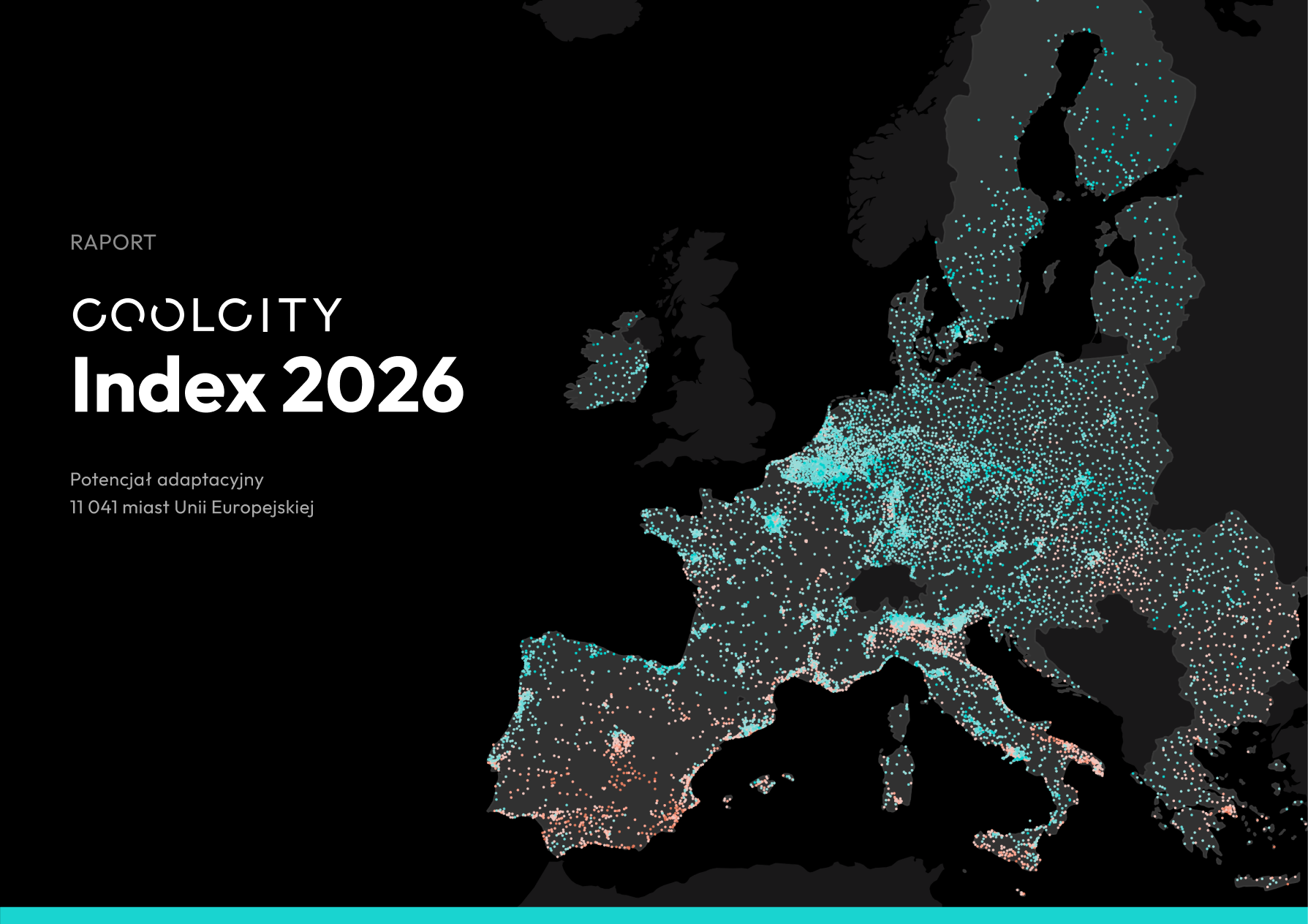
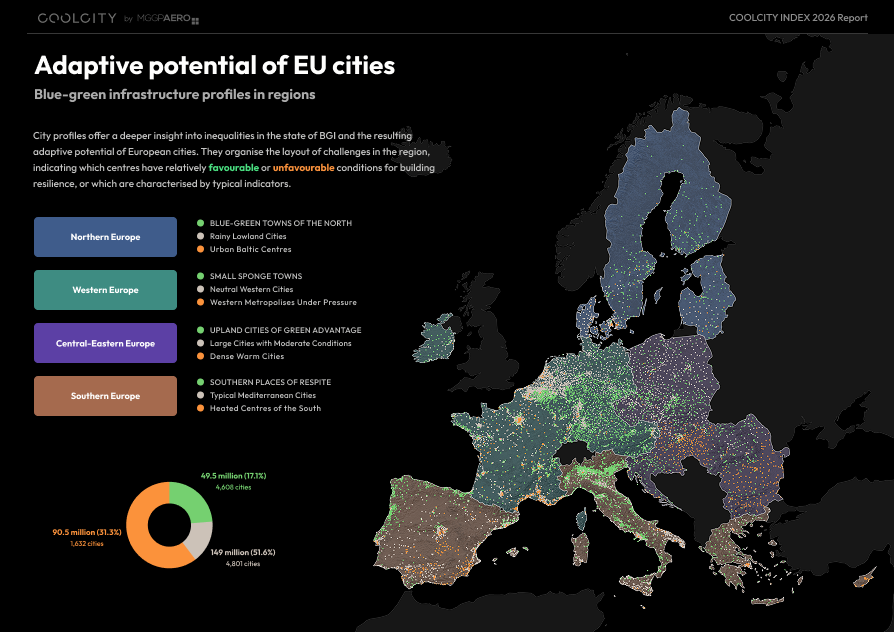
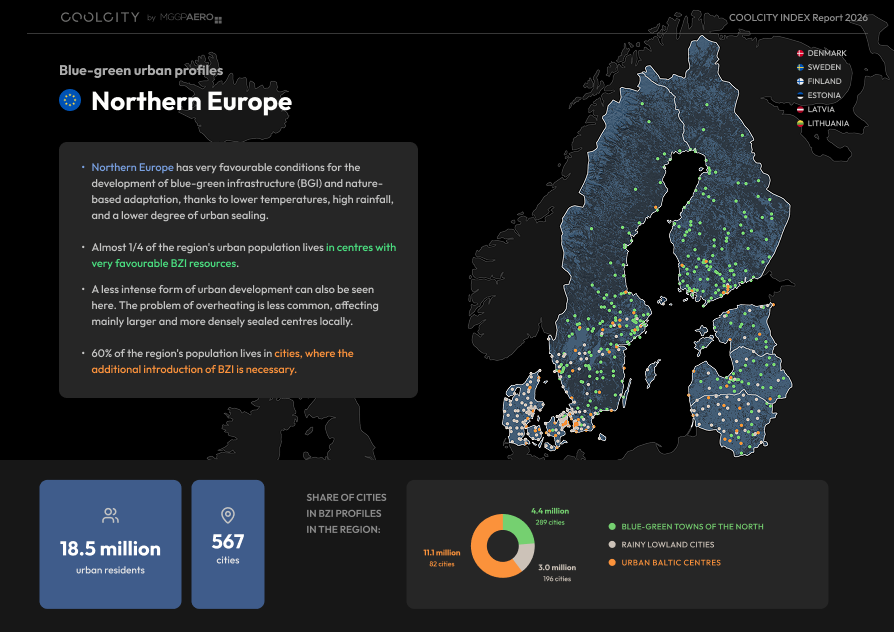
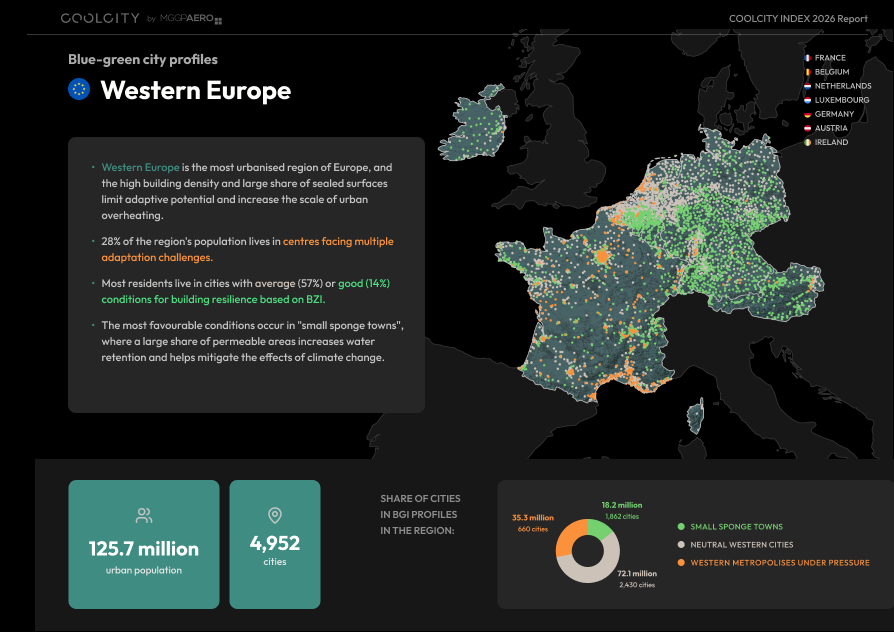
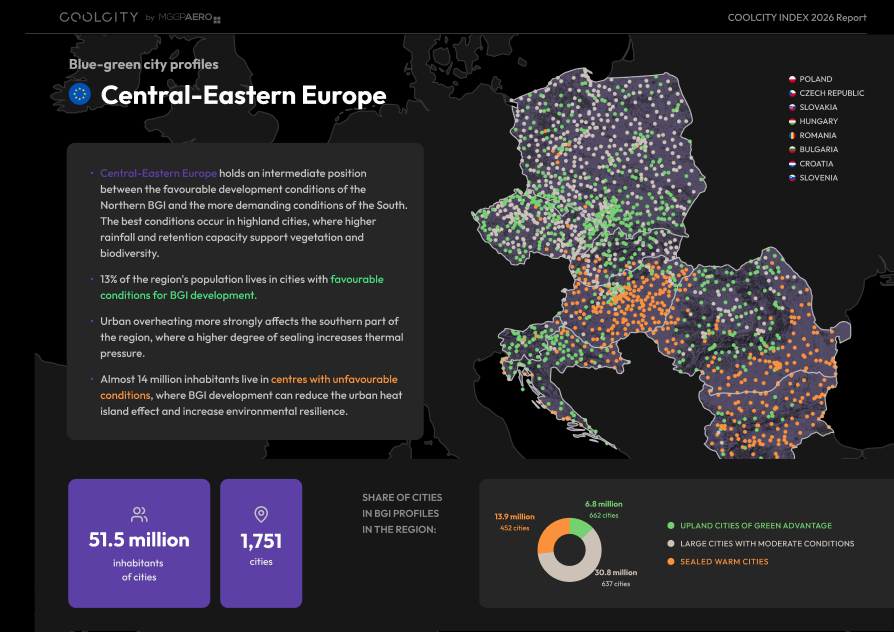
We present a report diagnosing the state of the blue-green infrastructure of over 11,000 cities in the European Union. We identify the greatest adaptation challenges in individual regions and present the situation of each country based on data from the COOLCITY Index 2026.
Key findings
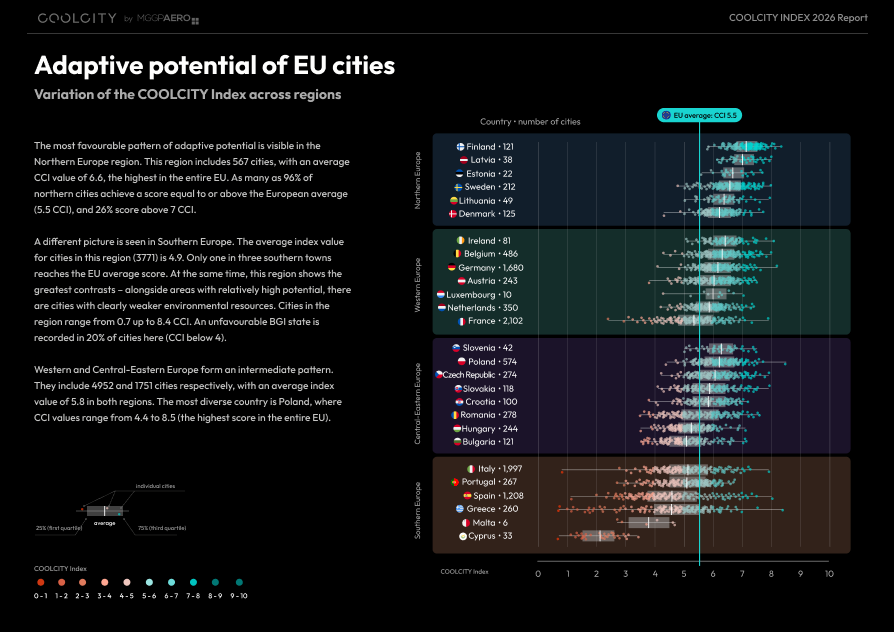
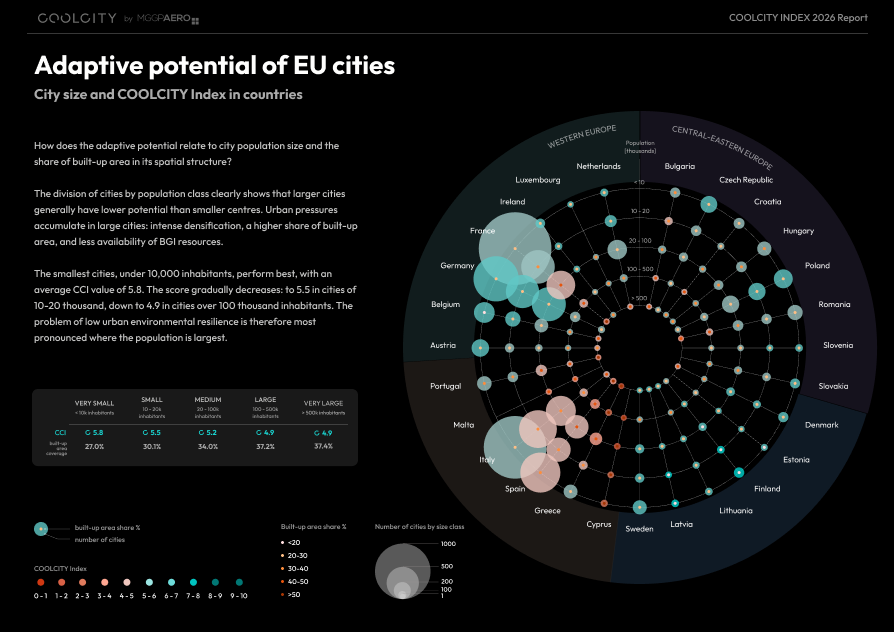
The highest adaptation potential is found in very small cities, under 10,000 inhabitants, regardless of region and profile
people live in resilient cities with a favorable profile and very good BGI condition
of Europe's population lives in urban areas with an unfavorable environmental profile
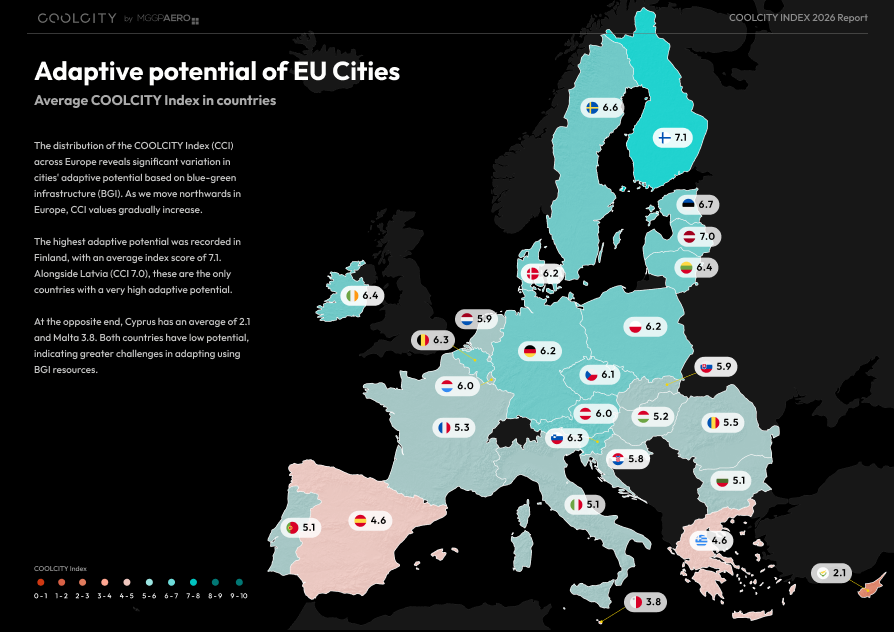
In over 800 EU cities, the environmental condition is very good there is a high potential for climate change adaptation (CCI >7). The highest proportion of such cities is in Finland (almost 60%)
More than 1,000 European cities have very low adaptive capacity based on BGI (CCI <4)
The greatest challenge is faced in Cyprus, where all urban areas reach very low CCI values (maximum 3.4 CCI)
The strongest correlation with a city's adaptive potential measured by the CCI index is population density and geographic location
The highest adaptation potential is found in very small cities, under 10,000 inhabitants, regardless of region and profile
people live in resilient cities with a favorable profile and very good BGI condition
of Europe's population lives in urban areas with an unfavorable environmental profile
In over 800 EU cities, the environmental condition is very good there is a high potential for climate change adaptation (CCI >7). The highest proportion of such cities is in Finland (almost 60%)
More than 1,000 European cities have very low adaptive capacity based on BGI (CCI <4)
The greatest challenge is faced in Cyprus, where all urban areas reach very low CCI values (maximum 3.4 CCI)
The strongest correlation with a city's adaptive potential measured by the CCI index is population density and geographic location
The highest adaptation potential is found in very small cities, under 10,000 inhabitants, regardless of region and profile
people live in resilient cities with a favorable profile and very good BGI condition
of Europe's population lives in urban areas with an unfavorable environmental profile
In over 800 EU cities, the environmental condition is very good there is a high potential for climate change adaptation (CCI >7). The highest proportion of such cities is in Finland (almost 60%)
More than 1,000 European cities have very low adaptive capacity based on BGI (CCI <4)
The greatest challenge is faced in Cyprus, where all urban areas reach very low CCI values (maximum 3.4 CCI)
The strongest correlation with a city's adaptive potential measured by the CCI index is population density and geographic location
Photo gallery
Press materials
About the report
Context
Effective adaptation begins with a good diagnosis. Local authorities need to know what resources they have, where nature requires protection, and where intervention is necessary. Only on this basis can they act consciously.
At COOLCITY, we have developed a method that allows cities to be diagnosed according to the same principles, regardless of their size or location. Its foundation is the COOLCITY Index (CCI) and five adaptive indicators: surface permeability, vegetation state, biodiversity, water conditions, and thermal conditions. We applied this method to cities in the European Union, and the results are available on the COOLCITY Index 2026 platform.
COOLCITY Index
The report is the next step in working with this data. While the platform allows users to delve into specific cities and check their results, the report adds an analytical and interpretative layer. It compiles the results, highlights the relationships evident in the data, and enables a better understanding of the context in which individual cities operate.
We will update and publish the COOLCITY Index platform along with the report annually, allowing us to track how the adaptive potential of European cities changes over time. The report is aimed at all those who wish to deepen their knowledge and make decisions based on reliable and objective data.
Authors
The authors of the report are experts from MGGP Aero © (2026) MGGP Aero Sp. z o.o.
The COOLCITY Index 2026 report was created as part of the Life COOLCITY project. The project is co-financed by the European Union through the LIFE programme and the National Fund for Environmental Protection and Water Management in Poland.
How to cite:
MGGP Aero. (2026) COOLCITY Index 2026 Report: Adaptive Potential of 11,041 Cities in the European Union coolcity.eu
We create tools for urban adaptation
Check today what COOLCITY can do for your city